A spring supplier can meet a drawing dimension and still fail the load, fatigue, traceability, or delivery requirements of an OEM program. By the end, you will have a practical method for building an RFQ, auditing production capability, reviewing PPAP evidence, and comparing suppliers against measurable acceptance criteria.
Key takeaways
- Send the controlled drawing revision with material, coating, testing, packaging, and delivery requirements.
- Match spring type and material to load, fatigue life, corrosion, and temperature demands.
- Audit coiling, heat treatment, inspection, and tooling controls for repeatable production.
- Request capability data, traceability records, sample reports, and evidence of delivery performance.
Convert the OEM Drawing Into a Complete RFQ
A reliable quotation starts with a complete RFQ package, not a drawing alone. Give the automotive spring manufacturer the controlled drawing revision and identify every requirement that affects tooling, material, processing, inspection, packaging, and delivery.
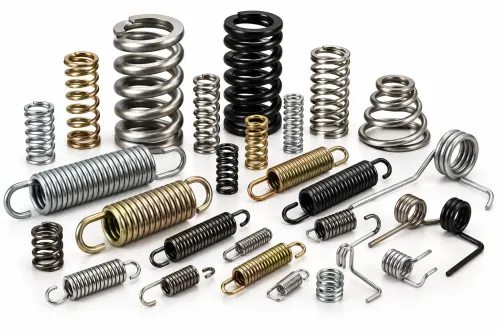
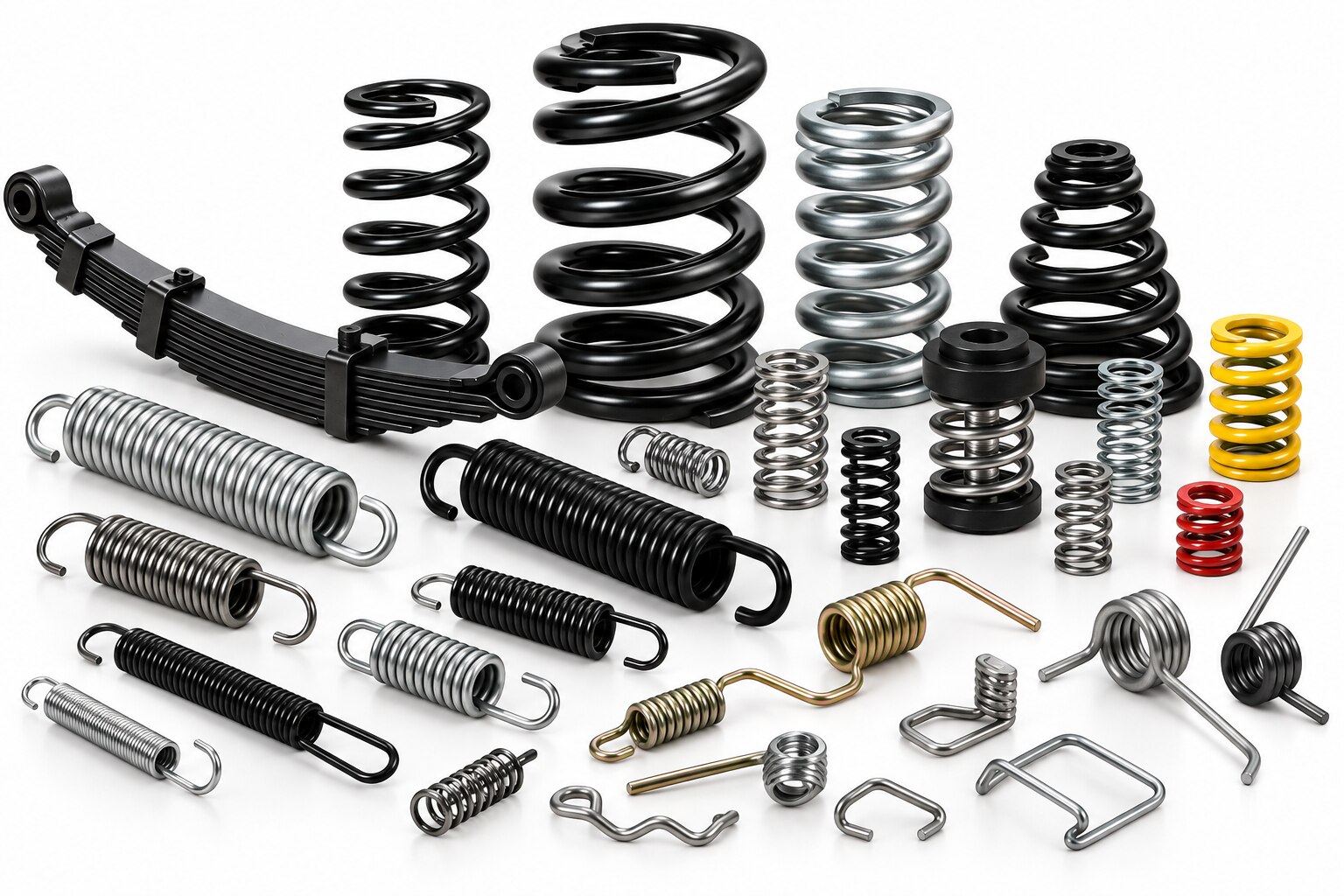
1. State the part type—compression, extension, torsion, wave, wire-form, or oil-seal spring—and the application, mating parts, orientation, and operating temperature.
2. Specify material grade and condition, wire diameter, free length, coil diameter, number of coils, end configuration, squareness, solid height, load at each specified height, working travel, spring rate, permanent-set limit, and every dimensional tolerance.
3. Define surface treatment, coating thickness, corrosion requirement, cleaning level, and packaging. For fluid-system parts, name the extraction fluid, particle-size threshold, maximum particle mass or count, and chemical-residue limits.
4. State annual volume, launch quantity, forecast horizon, batch size, delivery location, packaging quantity, and required submission timing. Identify whether tooling, gauges, prototypes, samples, or customer-owned dies belong in the quotation.
5. Attach applicable OEM requirements, special-characteristic symbols, test methods, fatigue-life targets, inspection frequency, approved deviations, and traceability rules. Request APQP and PPAP evidence, including the process flow, PFMEA, control plan, MSA, capability results, material certificates, performance records, and PSW.
6. Ask the supplier to confirm current IATF 16949 certification for the actual manufacturing site and processes, rather than accepting ISO 9001 or a certificate covering only engineering or trading activity.
Check Spring Type, Material, and Functional Performance
A supplier’s catalogue is not proof of OEM capability. Match the customer drawing to the actual process: compression spring, extension spring, torsion spring, wave spring, or oil-seal garter spring, then verify the supplier’s approved material and production method for that part number.
- Request the APQP and PPAP package, including process flow, PFMEA, control plan, MSA studies, capability results, material and performance records, approved deviations, and the PSW. Accept a dimensional report only as supporting evidence.
- Confirm the exact wire grade, diameter range, surface condition, and heat-treatment condition. For example, EN 10270 separates patented cold-drawn, stainless, and oil-hardened spring wires; a similar-looking substitute can change fatigue strength and corrosion behaviour.
- For coil springs, require load at each specified deflection, spring-rate results across the working range, squareness, end condition, solid height, coil index, and permanent-set results. Free length alone can pass while the spring binds or misses its load.
- Require testing on production-representative parts using a calibrated load-deflection rig. Fix the loading direction, seating method, deflection rate, dwell points, and temperature before comparing supplier results.
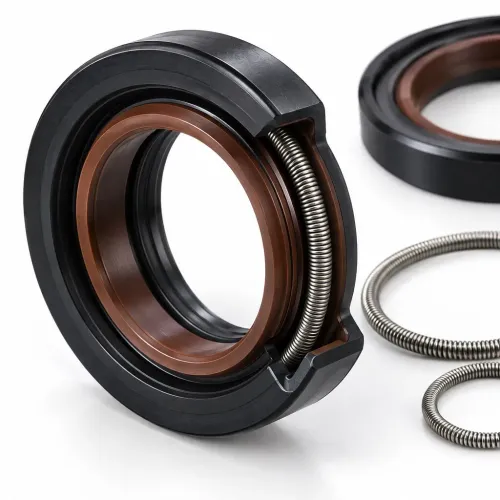
- For an oil-seal garter spring, identify whether the joint is welded, hooked, crimped, or otherwise joined. Verify joint pull strength, protrusion, end overlap, circumference or tension, and installation damage; a dimensionally correct joint can still cut the elastomer.
- Tie every result to the drawing revision, material lot, tooling condition, and customer-specific requirement. Ask for fatigue-life evidence when the application includes cyclic loading.
A supplier that cannot connect approved material certificates to functional test results has not demonstrated production readiness.
Audit Equipment and Process Capability for Repeatable Parts
A prototype shop can make one acceptable spring; an OEM supplier proves that the next lot will match it. Audit the equipment and controls in this order.
1. Match machines to the drawing. Check CNC coiling capacity, automatic gauging, end grinding, forming equipment for a wire-form spring, and dedicated tooling for the required diameter, pitch, ends and brackets. Ask which operations run in production, not only in the sample area.
2. Verify material and heat treatment control. The approved specification must identify the exact EN 10270 wire grade, diameter range, surface condition and treatment condition. Review furnace recipes, load configuration, atmosphere or salt condition, time-temperature records, quench controls, and hardness or microstructure checks across formed parts.
3. Test performance on production-representative parts. Require a calibrated load-deflection rig using your loading direction, seating method, deflection rate, dwell points and temperature. Different seating conventions make quoted spring rates incomparable.
4. Inspect the measurement system before accepting Cpk. Require MSA or gauge R&R for load, wire diameter, free length, squareness and bracket dimensions, then review control charts for tool wear and lot drift. A high Cpk from a short hand-selected sample proves little.
5. Audit oil-seal garter spring joints separately. Identify welded, hooked or crimped construction and control joint pull strength, protrusion, overlap, circumference, tension and elastomer damage during installation. A dimensional pass can still produce a leaking seal.
Confirm current IATF 16949 certification, the manufacturing-site address, scope, certification-body validity and coverage of actual spring, stamping, heat-treatment and assembly operations. ISO 9001 alone is not automotive process capability.
Demand Objective Evidence for Quality and Traceability
Ask for an APQP and PPAP package for each customer part number, not only a dimensional inspection report. The package must include the Process FMEA, process flow, control plan, MSA studies, capability results, material and performance records, approved deviations, and the Part Submission Warrant.
Check current IATF 16949 certification, including the manufacturing-site address, scope, certification body, expiry status, and covered processes. An ISO 9001 certificate does not prove automotive process control; a certificate covering trading or engineering activity is not enough.
Require these records before approval:
- MSA or gauge R&R studies for load, wire diameter, free length, squareness, and bracket dimensions.
- Control charts showing a stable process, not a high Cpk calculated from a short, hand-selected sample.
- Material certificates linked to wire or sheet heat and lot numbers.
- Heat-treatment, shot-peening, coating, machine, operator, final-test, shipment-date, and containment records.
- Fatigue reports linked to production lots, stress range, mean stress, cycle count, test frequency, failure definition, and surface condition.
| Record | What it proves | Investigate or reject when |
|---|---|---|
| PPAP and PSW | The submitted part and process meet agreed requirements | A PSW lacks approval or contains unexplained deviations |
| Traceability log | A failure can be contained by process lot and shipment date | The dispatch label has no heat-treatment or material link |
| Shot-peening record | Media, intensity, coverage, settings, presentation, and verification were controlled | The operation is recorded only as pass or fail |
| Fatigue report | Production-surface durability is demonstrated | Results come from polished laboratory wire only |
Compare Capacity, Delivery Reliability, and Supplier Fit
Annual volume should be tested against demonstrated output, not a machine count. Ask for capacity planning by part number: presses or coilers, shifts, tooling availability, changeover time, bottleneck operations, maintenance downtime, approved subcontractors, and reserved capacity after launch. Compare peak monthly demand plus safety margin with proven good-part output, not theoretical strokes per minute.
| Check | Strong evidence | Warning sign |
|---|---|---|
| Annual volume | Recent production run at comparable wire size, material and inspection load | Capacity claim based only on equipment nameplate |
| Delivery performance | Previous 12-month on-time-in-full record, expedite history and recovery plan | No measured delivery data or dependence on one machine |
| Launch fit | Named program owner, APQP and PPAP timing, spare tooling, escalation contacts and current IATF 16949 scope | Prototype responsiveness but no ramp plan |
| Lot traceability | Link from shipment date to wire heat or lot, machine, operator, heat-treatment and coating batches, and final test record | Dispatch serial number with no process-batch linkage |
Set a delivery baseline in the supply agreement: weekly call-off response, agreed lead time, minimum safety stock, notification period for tooling or process changes, and corrective-action timing. Review delivery performance monthly after start of production; a supplier that meets demand by expediting every shipment is not stable.
For springs and brackets, assess whether the same site controls forming, heat treatment, testing and containment. Shankar Spring And Coil Works should be judged against that evidence for the actual oil-seal spring or formed-component part number, not its ability to quote a sample.
Related product
 | We supply all types of oil seals springs. We supply all types of oil seals springs in both GI (Galvanized Iron) SS (Stainless Steel). View product → |
Frequently asked questions
What should an OEM include in an automotive spring RFQ?
Include the controlled drawing revision plus spring type, material grade, dimensions, tolerances, loads, fatigue or cycle requirements, surface treatment, inspection criteria, packaging, annual volume, delivery schedule, and tooling expectations.
How do you check whether a spring manufacturer can meet functional requirements?
Compare the proposed spring type and material with the required load, deflection, fatigue life, corrosion resistance, and operating temperature. Ask how the supplier verifies these characteristics on production parts.
What equipment and process controls should you audit?
Review wire forming or coiling machines, heat-treatment equipment, stress-relieving controls, end-grinding or forming operations, tooling maintenance, calibration, first-off approval, and in-process inspection records.
What quality and traceability evidence should an automotive spring supplier provide?
Request material certificates, batch or heat numbers, inspection reports, capability results, calibration records, nonconformance actions, process-control documents, and a clear link between finished parts and production lots.
How should you compare automotive spring suppliers beyond unit price?
Compare proven capacity, tooling lead time, production and delivery history, change-control discipline, packaging capability, communication, minimum order constraints, and the evidence supporting repeatable OEM supply.